

 by
by 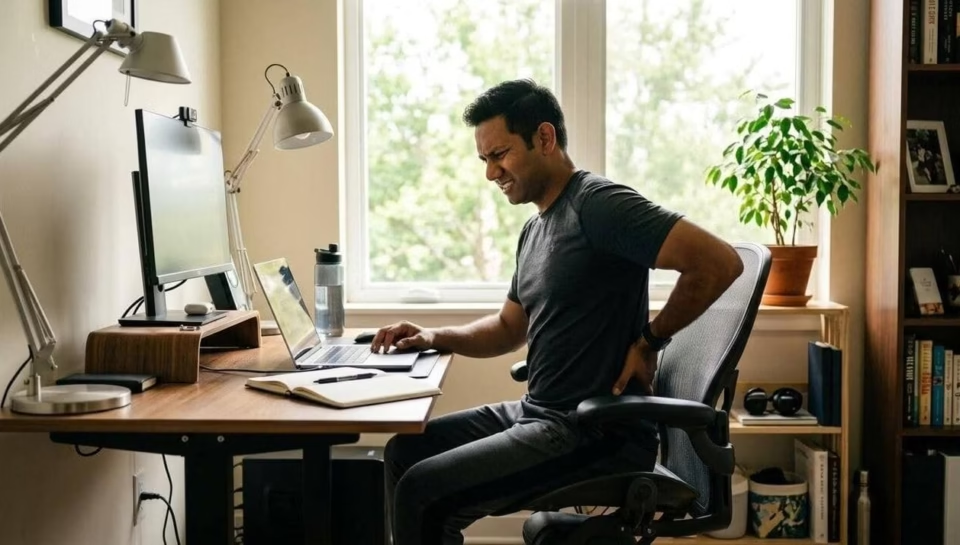
Core Strength Treatment for Back Pain: Why Crunches Aren’t Enough
Crunches and planks train your abdominal muscles, but they don’t address the full system your spine relies on for support during real movement. Core strength treatment in physiotherapy focuses on coordination, breathing, and functional control across the hips, pelvis, and deep stabilizers, not just ab endurance. If your back still hurts despite a regular core routine, a targeted assessment often reveals the missing piece.
You’ve been putting in the work. Crunches before work. Planks at the end of your run. A YouTube ab circuit on rest days. And yet, your lower back still tightens up after an hour at your desk, protests when you lift something from the floor, or flares up halfway through a pickleball match. It’s frustrating, and it’s more common than you’d think.
The issue isn’t effort. The issue is that most popular core exercises were designed with aesthetics or general fitness in mind, not spinal stability during real-life movement. There’s a meaningful difference between a tired core and a well-coordinated one.
This post breaks down what core strength actually means for your back, why a home routine often falls short, what signs point to a coordination problem rather than a strength deficit, and what physiotherapy looks like when it’s built around how you actually move.
If Your Abs Are Tired but Your Back Still Hurts, You’re Not Alone
Feeling soreness in your abdominals after a workout doesn’t automatically mean your spine is being supported the way it needs to be. The muscles you feel working during crunches or sit-ups are often the global movers, the large, surface-level muscles that generate force. The muscles your spine depends on most are the deeper stabilizers, and they respond to coordination cues, not fatigue.
Think about the moments when your back tends to speak up. Standing after a long work-from-home session. Reaching into the trunk of your car. Accelerating through a serve. Running on uneven ground. These movements all require your core to control rotation, absorb load, and transfer force between your upper and lower body in a fraction of a second. A plank held on a mat doesn’t train that sequence directly.
Exercise effort and movement control are two different qualities. Building one doesn’t automatically build the other.
Core Strength Is More Than Crunches and Planks
The core is not your six-pack. It’s a coordinated system of muscles that surrounds and stabilizes your spine from every direction. That system includes your abdominals, yes, but also the deep spinal muscles, the hips and glutes, the pelvic floor, the diaphragm, and the muscles along the mid and lower back. According to the Mayo Clinic, the core muscles serve as the central link in a chain connecting your upper and lower body, and nearly every movement you make engages them in some way.
The core’s primary job isn’t to bend your trunk. It’s to resist unwanted movement, transfer force efficiently, and keep your spine in a safe position while everything else around it gets to work. That’s a very different demand than what most isolation exercises train.
How Common Exercises Compare to Functional Core Training
| Exercise Type | What It Trains | What It Misses |
| Crunches / Sit-ups | Trunk flexion strength | Rotational control, load transfer, deep stabilizer coordination |
| Planks | Static endurance in one position | Dynamic control during movement, breathing under load |
| Functional Core Training | Control during bending, lifting, rotating, walking, running | N/A: designed to match real-life and sport demands |
Learning how to improve core stability means training the system to respond well during movement, not just to sustain a held position. That’s where functional training closes the gap.
Why Your Home Core Routine Might Not Be Helping Your Back
A home routine often falls short not because you’re doing something wrong, but because it wasn’t built around your specific movement patterns and symptoms. Several common reasons explain why core strengthening exercises for back pain don’t always translate into relief.
- The exercises are too advanced for your current movement control, so your body compensates through the low back, hip flexors, or neck instead of the intended muscles.
- Breathing and bracing aren’t coordinated. Holding your breath or bracing too hard during effort increases spinal load rather than reducing it.
- The exercises don’t match the movements that trigger your symptoms. Training a plank when your pain comes from rotation-based sport doesn’t address the actual demand.
- Stiffness in the hips, mid-back, or pelvis forces the lower back to do more than its share of the work, regardless of how strong your abs are.
- The volume is too high or too repetitive, which reinforces the same compensation pattern rather than building new movement quality.
Research published in the National Institutes of Health found that core stability exercise outperformed general exercise for reducing pain and disability in chronic low back pain, but the benefit came from exercises matched to the patient’s needs, not from volume alone. If symptoms persist despite consistent effort, the plan likely needs more specificity, not more repetitions.
A note worth stating clearly: if any exercise increases your pain or feels unsafe, stop and seek guidance. More reps through discomfort won’t fix the underlying issue.
Signs Your Core Needs Better Coordination, Not Just More Reps
These signs don’t diagnose anything, but they’re useful patterns to notice. If several of them sound familiar, they’re worth bringing to an assessment.
- Your low back tightens after prolonged sitting or a long day working from home.
- You feel discomfort during lifting, squatting, running, or twisting through sport.
- Single-leg movements like lunges or running feel unstable or uneven.
- You hold your breath during physical effort without realizing it.
- Your lower back arches during exercises like planks, bridges, or leg lifts.
- You feel fatigue or discomfort before the target muscles feel engaged.
These patterns often point to a coordination gap rather than a simple strength deficit. The goal isn’t to identify one “weak” muscle. It’s to understand how your whole movement system is organized and where the load is landing.
What Core Strength Treatment Looks Like in Physiotherapy
Physical therapy for core strength starts with assessment, not a workout prescription. Before any exercises are assigned, a physiotherapist works to understand what’s actually happening in your movement, because core weakness and lower back pain interact differently from person to person.
What a Physiotherapy Assessment Covers
- Your pain patterns and the activities you want to get back to
- Spine, hip, and pelvic movement and mobility
- Breathing and bracing coordination
- Balance and single-leg control
- Lifting, squatting, running, or sport-specific movement patterns
What Treatment Involves
A study from the National Institutes of Health on core strength training for chronic low back pain found that targeted, progressive core exercise programs were associated with meaningful reductions in pain and disability. Treatment at a physiotherapy clinic builds on that foundation with a personalized approach.
- Education on how to move with more confidence and less compensation
- Hands-on care where appropriate to support comfort and mobility
- Progressive core strengthening exercises for back pain, matched to your current ability
- Functional core training that carries over into daily life, sport, and work
Plans are adjusted as your body responds. There’s no single protocol that works the same way for a runner, a remote worker, and a pickleball player. The emphasis shifts based on your goals and how you’re moving.
Build a Core That Works When Life Gets Moving
Progression in functional core training follows a clear path from basic awareness to real-world strength.
- Learn to breathe and brace without gripping or holding your breath.
- Build control in stable positions: lying on your back, sitting, hands-and-knees.
- Progress to standing, carrying, lunging, and rotating with control.
- Add balance-based and anti-rotation movements that challenge the system dynamically.
- Build toward sport-specific demands: running mechanics for runners, lateral movement for pickleball players, sustained positions for desk workers.
The goal isn’t a longer plank time. It’s a body that feels prepared for the activities that matter to you, with more control and less guessing on every rep.
Key Takeaways
- The core includes the deep spinal stabilizers, hips, pelvis, pelvic floor, and diaphragm, not just the abdominals. All of them need to coordinate for the spine to be supported during movement.
- Crunches train trunk flexion. Planks train static endurance. Neither teaches the spine to respond well during real-world movements like lifting, rotating, or running.
- Research supports core stability exercise over general exercise for chronic low back pain, but the benefit depends on specificity, not volume.
- Common reasons a home core routine doesn’t help include compensation patterns, poor breathing coordination, and exercises that don’t match the movements causing symptoms.
- Signs like breath-holding during effort, low back arching during exercises, and pain during single-leg movements often point to a coordination problem, not just a strength deficit.
- Physiotherapy assessment looks at how you actually move before prescribing exercises, and adjusts the plan based on your response over time.
Ready for a Plan That Actually Fits How You Move?
If crunches and planks haven’t helped your back feel ready for real life, it’s worth taking a closer look at how your whole movement system is working together. At BeActive Physio in Oakville, we work with active adults, remote workers, runners, and weekend warriors to understand how they move, build practical core strength, and get back to the activities that matter to them. Book a physiotherapy assessment and get clear guidance, targeted exercises, and a plan built around your goals.
Frequently Asked Questions
Are crunches bad for lower back pain?
Not always, but they aren’t the right starting point for everyone. Crunches train trunk flexion, which puts load through the lumbar spine in a flexed position. If that movement pattern is already contributing to your symptoms, crunches are unlikely to help and could increase discomfort. A physiotherapist can assess whether they fit your situation and suggest exercises that better match your movement needs and goals.
What are the most effective core strengthening exercises for back pain?
The exercises that tend to be most useful depend on your symptoms, movement habits, strength, and activity demands. Many people benefit from a progression that begins with breathing and bracing, then moves through pelvic control, bridges, bird dogs, carries, and standing anti-rotation exercises before adding sport-specific or dynamic challenges. Starting with control and building from there tends to produce more meaningful results than starting with high-load or high-rep exercises.
How long does core strength treatment take to make a difference?
Timelines vary based on the underlying cause of symptoms, your current movement patterns, how consistently you practice, and what activities you’re working toward. Many people notice gradual improvement in their comfort and movement control as the plan progresses. The focus is on building better coordination over time and adjusting the approach based on how your body responds, rather than following a fixed schedule.